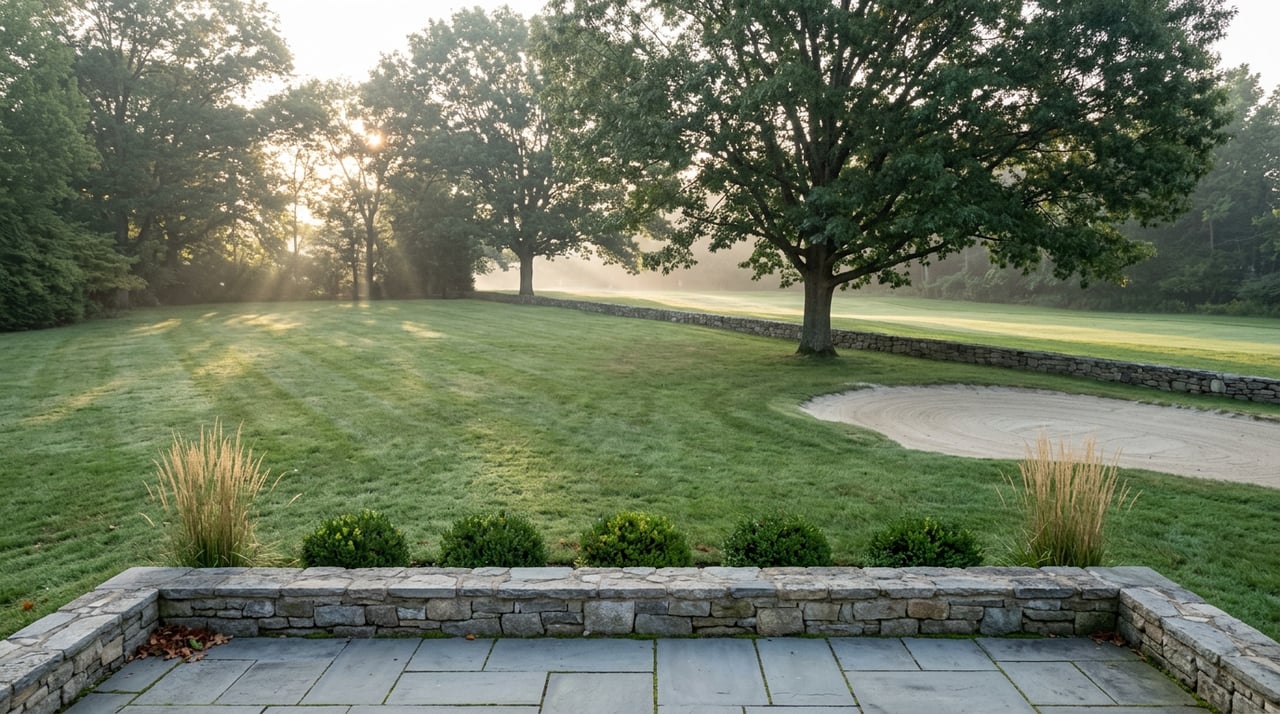
A buyer we spoke with last spring had already fallen for a lot backing to the ninth fairway in White Eagle. The view sold her before the floor plan did. What she didn't expect, until her contractor pulled the covenants, was that the deck she wanted to build would need architectural review not just for materials and setback, but for height and sightlines, because the lot touched the golf course. Her neighbor two streets over, on a lot that didn't back to the fairway, needed none of that.
That gap between two houses in the same subdivision is the story the median price never tells. Naperville's golf-course communities get marketed as a single category, a shorthand for prestige and manicured views. In practice they are four distinct clubs with different histories, different ownership structures, and different rules attached to the exact same amenity, and even within one club the lot you choose changes what you're actually buying.
The Citywide Backdrop, Briefly
Naperville itself has been holding steady rather than moving sharply. As of early August 2026, the market showed roughly 1.3 to 2.9 months of supply depending on the measure, a tight, seller-favoring inventory picture, with listings taking about 43 to 44 days to sell. Zillow put the typical home value at $636,281 as of June 30, 2026, while the median sale price ran closer to $574,500 as of the end of May. Those figures disagree because they measure different things over different windows, which is itself the point: in a market this size, a single citywide number rarely describes any specific property well. Golf-course lots are where that gap widens the most.
Four Clubs, Four Different Bets
Naperville's private and semi-private course communities did not grow up as one product. Each was built by a different developer, at a different time, around a different idea of what a club should be.
| Community | Course Origin | Ownership Structure | Defining Character |
|---|---|---|---|
| White Eagle | 27-hole course designed by Arnold Palmer and Ed Seay | Master-planned residential community, HOA-governed | Resort-style pools, eight lighted tennis courts, 1,085 homes, built primarily 1987 to the mid-1990s with a newer Eastman Custom Homes section added in 2017 |
| Cress Creek Country Club | Founded 1963, designed by David Gill, renovated 2008-2009 by Ron Prichard | Member-owned equity club since December 1988 | Family-oriented, three pools, plantation-style clubhouse |
| Tamarack Golf Club / Tamarack Fairways | Championship course | Semi-private club, HOA-governed residential surrounds | Larger lots, custom construction, mature landscaping |
| Naperville Country Club | Redesigned 2006 by Steve Forrest of Arthur Hills/Steve Forrest & Associates | Private club | 124-acre course through rolling terrain and mature trees, centrally located |
A buyer comparing these on price alone is comparing four different products that happen to share a category label. White Eagle sells a resort amenity package. Cress Creek sells member equity in a club its residents effectively own. Tamarack sells acreage and privacy. None of that shows up in a portal filter for "golf course."
The Same Community, an Eight-Times HOA Spread
Here is the number that should stop a comparison-shopping buyer cold. Within White Eagle alone, reported HOA fees range from $80 to $644 a month, an eight-times spread inside one subdivision. That range reflects the mix of product built there over three decades, from smaller condos and townhomes to large executive lots, each carrying a different assessment for shared amenities, security, and reserve funding.
Compare that to Hobson West, a nearby established Naperville neighborhood built mostly in the early 1980s without a golf course attached. Its HOA fees run between $43 and $58 a month, and residents there have described the association as prioritizing community connection over strict design enforcement, with more flexibility on things like fence styles and exterior colors.
The lesson isn't that golf-course living costs more, though it often does. It's that "golf-course community" collapses several very different fee structures into one phrase, and the only way to know which one applies to a specific house is to read that house's specific HOA documents rather than the neighborhood's reputation.
A golf-course address is not a single price. It is a bundle of separate costs and restrictions that happen to share a ZIP code.
Why the Course Restricts Your Deck Before It Restricts Your Neighbor's
The HOA fee spread is the visible cost. The design restriction is the one buyers tend to discover after closing.
White Eagle's architectural review, managed through the Property Owners Association with support from RealManage, treats golf-adjacent lots differently by design. Materials and colors need to complement the existing brick and stone character throughout the community, but lots that touch the course or common areas face additional scrutiny specifically around sightlines, structure height, and footprint, whether the project is a deck, a pergola, a fire pit, or an outdoor kitchen. A homeowner two lots away, with no golf-course frontage, submits a simpler application.
This is the trade a fairway view actually asks for. The scenery that makes a lot desirable is also scenery the club has an interest in protecting from every other angle, which means the same feature that raises a lot's appeal also raises the bar for what you're allowed to build on it. It is worth asking, before writing an offer on a golf-adjacent lot, whether the specific outdoor renovation you're picturing would clear that review at all.
The other side of that same trade shows up in listing language itself. Homes positioned away from active tee shots and doglegs are sometimes marketed specifically for being safer from stray shots, a detail that only matters, and only becomes a selling point, on a golf-course lot. It's a small signal that the risk is real enough to price around, not just a lifestyle footnote.
What the Headline Median Is Hiding
Search for White Eagle's median home price and you'll find numbers that appear to contradict each other, sometimes by hundreds of thousands of dollars. That isn't a data error. It's what happens when a single median tries to describe a community that spans condos, townhomes, and seven-figure estates on the same fairway.
Public sales records for White Eagle Drive itself, the street running closest to the course, show a tighter and more useful picture: closings between roughly $1.325 million and $1.65 million from mid-2025 into early 2026. That range describes the custom-home tier actually sitting on the course. Tamarack Fairways has shown a similar pattern in its own recent sales, generally landing in the high $800,000s to low $900,000s, reflecting its larger-lot, custom-build character rather than the community's full price spread.
The takeaway for anyone comparing these neighborhoods is to ask which slice of the community a quoted median actually describes, and to request comparable sales for the specific street or product type rather than the subdivision as a whole. A club-wide number is a starting point for a conversation, not a substitute for one.
One More Variable: Which Side of the County Line
White Eagle itself straddles the DuPage-Will county line. Residents on both sides share the same Naperville ZIP code, park district access, and Indian Prairie School District 204 assignment, but municipal services including police, fire, and ambulance divide between Naperville and Aurora depending on which side of the line a specific address falls on. As of early August 2026, the county-level tax gap across Naperville generally was meaningful: DuPage County reported a median effective property tax rate near 2.05 percent against a median home value of $443,310, while the Will County side reported roughly 2.35 percent against a median value of $544,293. Those figures apply citywide, not to any single golf-course lot, so the only reliable way to know a specific property's number is to run that address through the county assessor directly rather than assume based on subdivision name.
Questions Worth Asking Before You Write an Offer
A golf-course lot in Naperville rewards buyers who ask more specific questions than the listing photos invite.
- What does this specific lot's HOA fee cover, and how does it compare to the range reported for the broader community?
- Does this lot's location trigger additional architectural review for decks, pergolas, or fire pits, and would the outdoor project you're planning clear that review?
- Which side of the county line does this address sit on, and what is its actual current tax bill rather than a subdivision average?
- What have comparable homes on this specific street, not the subdivision at large, closed for in the past twelve months?
- Is the course orientation such that errant shots are a realistic consideration for this lot, or is the lot positioned away from active play?
None of these questions show up in a portal search filter. All of them change what a golf-course address actually costs to own.
A fairway view is a genuine amenity, and Naperville's four clubs each offer a distinct version of it. But the price on the sign is the beginning of the comparison, not the end of it. If you're weighing a specific lot in White Eagle, Cress Creek, Tamarack Fairways, or at Naperville Country Club and want the HOA documents, recent comparable sales, and architectural review requirements read together before you commit to anything, Jill Clark can walk through the specifics with you. Request a Private Consultation to start that conversation.